
Our Family Portraits
Take turns tracing facial features on a clear acrylic frame, then compare the portraits. Your child practices close observation and drawing while celebrating family connection.
- 4 years
- Some prep
- At home
- About 15 minutes
Developmental benefits
- Social/Emotional:Taking turns tracing family faces and noticing similarities supports your child’s sense of identity and belonging.
- Movement:Drawing facial features on a clear acrylic frame with paint markers builds control of the drawing tool.
Preparation
What You’ll Need
- 1
A clear acrylic frame or panel
- 2
paint markers in several colors
Step 1
Draw the Grown-Ups in Our Family
Turn your child’s love of drawing into a family portrait game. Hold the clear frame in front of your face and let your child trace the features they see through it. Invite them to notice small details as they draw.
What to notice
- Traces your facial features on a clear acrylic frame
 Fine Motor
 - Talks with you about your facial features, such as “Mom’s eyes are round.”
 Communicating and Speaking
Tips
- Drawing on acrylic feels different from drawing on paper. Let your child make a few free marks first, wipe the surface clean, and then begin the portrait.
- When your child moves from one grown-up to another, compare features: “Whose eyes look bigger?”
- The portrait does not need to be exact. The goal is to notice and represent what makes each face distinct.
Step 2
Now Draw My Face
When your child finishes, switch roles. Ask them to hold the frame as you trace their features. Describe what you see—the shape of their eyes or nose—to deepen their awareness of their own face.
What to notice
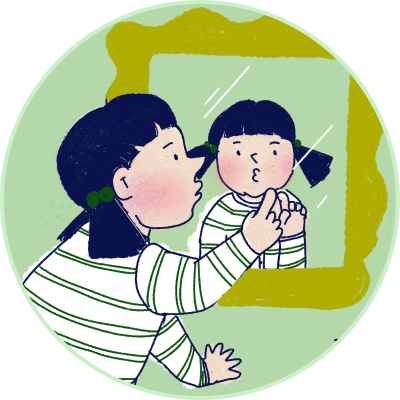
- Touches their own face, studies the portrait, and describes personal features
 Sense of Identity and Belonging
 - Smiles while you focus on drawing their portrait
 Emotional Functioning
Tips
- Use descriptive words to make each feature more specific: “Your eyes are round like two little grapes.”
- Notice family similarities too: “Your eyes are round like mine.”
- Use warm, neutral language. Avoid ranking or teasing anyone’s features; focus on observation and uniqueness rather than attractiveness.
Step 3
We’re a Family
Place all the portraits together and compare what is alike and different. Help your child notice that they are part of the family, then invite them to add playful decorations to every portrait.
What to notice
- Notices a family resemblance and says they are part of the family Sense of Identity and Belonging
- Adds decorations with bold colors and expressive marks
 Creativity
Tips
- Invite your child to imagine a future family portrait: “Will Dad have a white beard in ten years? How tall do you think you’ll be?”
- Offer glitter stickers, pom-poms, or other craft materials to make decorating more playful.
- Look for similarities before differences: “Are all our eyes round?” “Who has a beard?” Use the conversation to reinforce, “We’re a family.”
Better Parenting Content Team · Updated September 11, 2026