
Measure in Everyday Life
Use hand spans, footsteps, cups, and other familiar units to compare length, capacity, and weight at home.
- 5 years
- Quick prep
- At home
- About 5 minutes
Steps
- 1
Standard units such as meters and kilograms can feel abstract to a young child. Begin with informal measurement using their body or familiar household objects to compare length, capacity, and weight.
- 2
For length, use hand spans, footsteps, shoes, blocks, or a piece of thick string: “The table is six hand spans long.”
- 3
For capacity, use cups, spoons, bottle caps, or small buckets: “The pitcher holds four cups of water.”
- 4
For weight, let your child hold, lift, or carry two objects: “The apple feels heavier than the orange.”
- 5
Everyday routines offer natural chances to measure and compare. Your child might scoop half a bowl of rice while cooking or lift two bags to find which feels heavier.
- 6
Experiences like these help your child build practical ideas of longer and shorter, more and less, and heavier and lighter before learning standard units.
What to notice
- Measures the length of the table using their palm as a unit
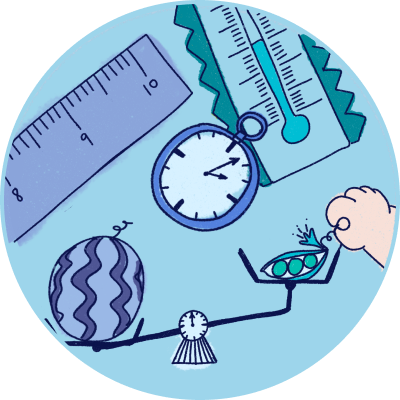 Measurement
- Sorts several objects by weight
 Vocabulary
Tips
- Invite your child to count as they measure: “One block, two blocks, three blocks,” “How many steps?” or “How many cups of water?”
- Gently model consistent measuring: place units end to end, without overlaps or gaps, and keep measuring in the same direction.
Developmental benefits
- Cognitive: Measuring with informal units in several ways gives your child experience comparing object properties before they encounter standard units.
- Language: Using words for length, size, and other object properties while measuring and comparing helps your child understand and apply descriptive vocabulary.
Better Parenting Content Team · Updated September 11, 2026