
Close Your Eyes and Feel the Shape
Make sturdy shape cards, then invite your child to feel one with their eyes closed and guess which shape it is.
- 5 years
- Quick prep
- At home
- About 15 minutes
Steps
- 1
Cut sturdy cardboard into several shapes, such as a circle, triangle, rectangle, square, and pentagon.
- 2
Before the game, feel each shape together and name its features: a circle has one smooth curved edge, a triangle has three corners, and a rectangle has two long sides and two short sides.
- 3
Ask your child to close their eyes, choose one shape card, and feel it. “What shape do you think it is?”
- 4
A circle may be easy to recognize, while a rectangle and pentagon can take more careful exploration.
- 5
If the first guess is not right, ask about a defining feature. If your child calls a rectangle a square, for example, ask, “Are all four sides the same length?”
- 6
When the guess is right, ask, “How many sides did you feel? How many corners?” to revisit the clues.
- 7
Then switch roles. Let your child choose a shape and see whether you can identify it by touch.
What to notice
- Identifies a shape by feeling only its edges and corners
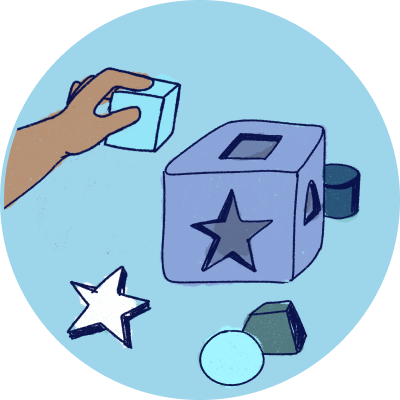 Geometry and Spatial Sense
 - Uses words such as “edge” and “corner” to describe the shape they are holding
 Communicating and Speaking
Tips
- Counting sides and corners without looking can be confusing. Your child can hold one corner or side with one hand as a starting point, then trace all the way around with the other.
- If they still cannot identify the shape, open their eyes and compare what they felt with what they see.
Developmental benefits
- Cognitive: Feeling the edges and corners of a shape without looking helps your child notice and compare defining features of different shapes.
- Language: As your child explains their answer, they practice using words such as "side," "corner," "long," and "short" to describe a shape more clearly.
Better Parenting Content Team · Updated September 11, 2026